


You are here
Toutes les actualités
Combating Child Labor in Cocoa Farming: CNS Mobilizes Ananguie Communities for Sustainable Cocoa
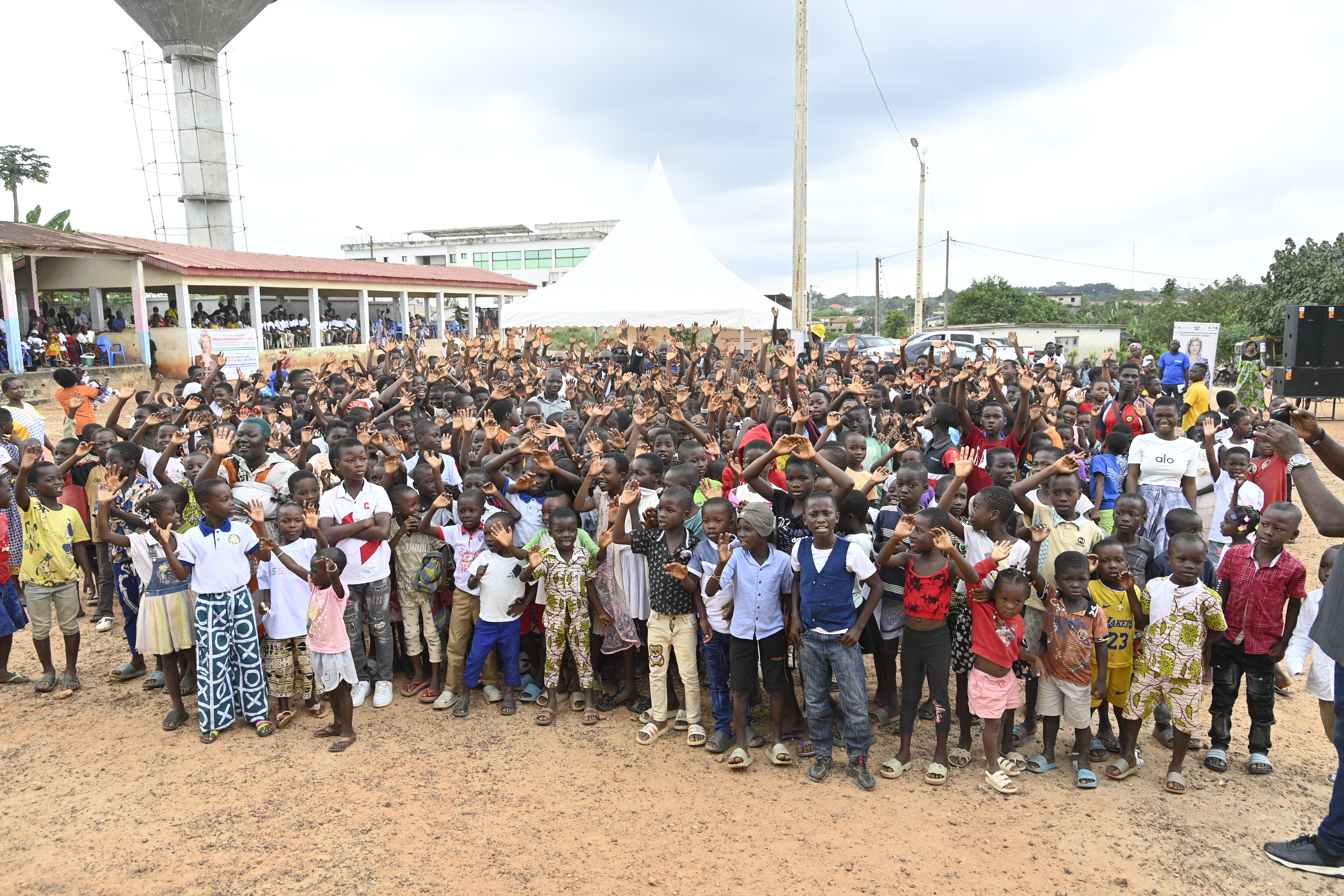
On Friday, August 28, 2026, more than 500 cocoa farmers, children, traditional chiefs, and religious leaders gathered in Ananguie (in the Adzope sub-prefecture) for an awareness-raising campaign regarding the dangers of child labor in cocoa farming. The initiative was led by the National Oversight Committee for Actions to Combat Child Trafficking, Exploitation, and Labor (CNS), chaired by First Lady Dominique Ouattara.
"For sustainable cocoa, let’s say no to child labor." This was the theme under which the CNS launched its annual awareness campaign—conducted during the school holidays—in Ananguié. Organized in collaboration with the Ananguie Simplified Cooperative Society (SCSAG), the event brought together over 500 cocoa farmers, as well as numerous children and community leaders from Ananguie, Biasso, Ahouabo, Bouape, and Escaf.
The meeting had a clear objective: to remind communities that child protection is essential to the long-term viability of the cocoa sector and to preserving the reputation of Ivorian cocoa on international markets. Mr. Amany Konan, the National Consultant for Combating Child Labor at the Office of the First Lady and the campaign’s lead speaker, began by commending the commitment shown by cocoa farmers.
He then addressed the economic and social issues surrounding the elimination of child labor. He noted that over 67% of Ivorian cocoa is exported to the European Union market and that cocoa accounts for more than 74% of Côte d’Ivoire’s exports to the United States.
Against this backdrop, international market demands are evolving. Importing countries are tightening their standards, making market access conditional upon compliance with environmental, economic, and social criteria. Consequently, cocoa traceability—specifically regarding production conditions and the absence of child labor—is becoming a critical issue for the sector's future. "Dear cocoa-farming parents, you must understand that we can no longer continue to grow cocoa the way we did in the past. Things have changed. We must respect children's rights and put an end to child labor," Mr. Amany Konan emphasized.
Particular emphasis was placed on hazardous work prohibited for children. This includes, in particular, the handling of pesticides, herbicides, fungicides, insecticides, and other agrochemicals. Artisanal gold mining, which also exposes children to significant health risks, was the subject of a specific warning. Parents were urged not to assign their children tasks that are too arduous or dangerous for their age and that could compromise their health, physical and mental development, or schooling.
During his address, Mr. Amany Konan also highlighted the key actions undertaken by the First Lady, Mrs. Dominique Ouattara, as part of her commitment to combating child trafficking, exploitation, and child labor. He specifically cited initiatives promoting children's schooling through the construction of classrooms and school canteens in vulnerable rural areas. He also mentioned the Support Fund for Women of Côte d’Ivoire (FAFCI), which contributes to women's economic empowerment and, consequently, to improving families' living conditions.
In addition to these efforts, reception and transit centers for child victims of trafficking and exploitation have been built in Soubre, Ferkessedougou, and Bouake, alongside the construction of the "Safe Home" in Adiake to protect abused women.
The Dominique Ouattara Mother and Child Hospital in Bingerville, which provides specialized care for women and children, was also highlighted as a major achievement within this policy of protecting and promoting family well-being.
For the CNS, the Ananguié campaign contributes to intensifying efforts driven by the First Lady. It aims to raise community awareness regarding the consequences of child labor and to reiterate that a child’s place is primarily in school, within a protective family and community environment.
The support of producers, coffee and cocoa cooperatives, and community leaders is also being sought; for beyond government action, the fight against child labor relies on the responsibility of all stakeholders in the sector.
Over 500 school kits distributed
The campaign also placed significant emphasis on schooling. More than 500 school kits were distributed to children from vulnerable cocoa-farming families.
Top-performing primary school students received educational tablets—a gesture intended to encourage their academic efforts and to remind communities of the importance of educational success.
Speaking on behalf of coffee and cocoa farmers, Mr. Assépo Charles, Chairman of the Board of SCSAG, expressed the cooperative’s and its members' gratitude to the First Lady.
He commended her commitment to the well-being of farmers' children and families, as well as her efforts to safeguard the reputation of Ivorian cocoa. He noted that the message conveyed by Mr. Amany Konan had resonated with the local population. The SCSAG Chairman also reaffirmed the cooperative’s and its members' support for the CNS’s initiatives and their determination to play an active role in the fight against child labor.
Beyond the issue of child labor, the meeting provided an opportunity for the people of Ananguie to voice their concerns. Through Mr. Assépo Charles, they appealed to the First Lady for assistance in securing access to clean drinking water for the village. As Ananguie currently lacks a running water network, residents also expressed a desire for their locality to be upgraded to the status of a sub-prefecture. Another request was made with particular emphasis: an invitation for the First Lady, Mrs. Dominique Ouattara, to visit Ananguie—a plea fervently echoed by the assembled crowd.
Organized with SCSAG in partnership with the Coffee-Cocoa Council and the "Les Amis de San Pedro" Association, the campaign was attended by the representative of the Adzope sub-prefect, the Adzope Regional Director of Agriculture, and the Agboville Regional Delegate of the Coffee-Cocoa Council.
The meeting concluded in a festive atmosphere. Traditional dances and performances by artists from the Mé region accompanied this community mobilization centered on a shared message: protecting children also means safeguarding the future of the Ivorian cocoa sector.